Going South in September

Going South in September

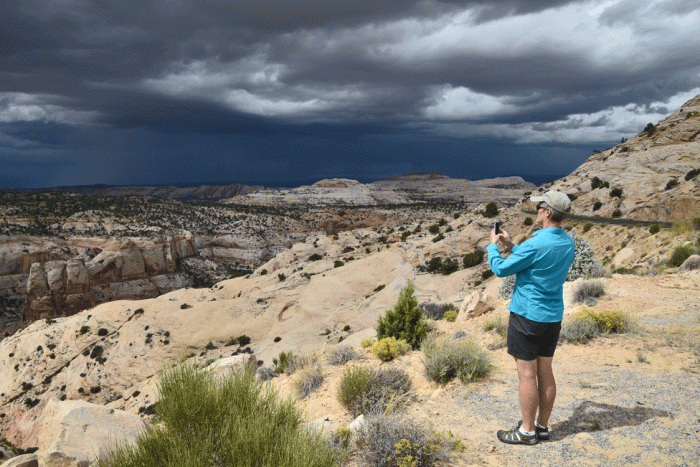
This September trip was meant to start with the Sisters Folk Festival, but wildfires and the resulting poor air quality forced the festival to cancel. We didn’t know this for sure until we were in Central Oregon and five hours into our second day of driving. So we regrouped. While Wendy stocked the trailer with groceries, (we’d already missed our planned Costco stop) Doug searched for the closest place out of the smoke and made a reservation at an RV park in Lakeview, Oregon; another four hour drive. The smoke cleared after a thunderstorm when we were just about at Lakeview, so although we travelled on roads that were new to us, we didn’t see much of the landscape.

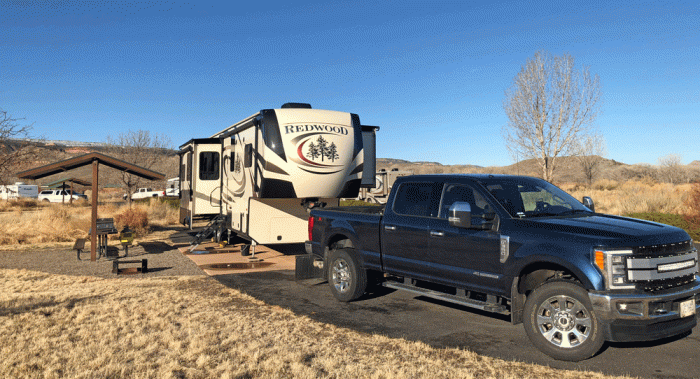
We stayed two nights at the Junipers RV Resort, about 10 miles west of Lakeview, and it was perfect for us. We breathed clear air under sunny skies, hiked trails from the RV park, visited museums in Lakeview and did some bird-watching on the nearby reservoir. Here’s a photo of Wendy and Tali under blue skies at the Junipers RV park and a photo of an old quilt in the Schminck Museum in Lakeview. The Schmincks ordered their house from a Sears-Robuck catalogue and throughout their lives, collected a wide array of items, from household to firearms, and set up a free museum in their basement. Their whole house is now a museum, funded by private donations.

The time in Lakeview also allowed us to plan where to go next, since our idea to visit Crater Lake was also a “no-go” due to smoke. So we made an itinerary that used the time before our Bryce Canyon reservation on September 15. Which is how we ended up in Wells, Nevada for two nights. Wells is a community of 1500 where dilapidated motels decay in the once thriving downtown, and all the new hotel construction is out by the interstate.

Wells was a good place to stage from to visit Ruby Lakes National Wildlife Refuge, an hour and a half drive south on the main highway and secondary and gravel roads. Once covered by a 200-foot deep ancient lake, the “Ruby Marshes” now provide habitat for hundreds of species of birds and mammals. There is an auto-driving route on the dikes that were not crowded, so we could stop almost anywhere that we chose. We got some close views of a Virginia Rail and a Sora.

We saw many White-faced ibises, both flying and standing still. The white-face on a White-faced ibis is only discernable on the dark bird during breeding season, but the bird has a red iris (which is inconveniently blocked by a reed in the photo below) to distinguish it from a glossy ibis. We had a good look at a lone gull-like bird, which even with a photo is difficult to identify, but we’re going with a Forster’s Tern.

Wendy set up the scope with her “PhoneSkope,” which allowed her to take photos of a Great blue heron preening and sipping water. (Heron Yoga)

We realized that there was a national park we had barely heard about that was close to our route to Utah, so we stopped at Baker, Nevada to visit Great Basin National Park. The “Whispering Elms” was a motel, RV park, tent campground and bar all in one. It had plenty of shade. We’ve developed an uneasy fondness for gravel over the years because it’s not dusty or muddy.

On our first afternoon, we left the 30 degree heat of the valley floor and drove up the winding Wheeler Peak Scenic Drive to about 10 000 feet. (It’s funny how we are metric with temperature, but not with elevation.) We enjoyed the cooler air on a trail up to a bristlecone pine grove. (1½ hours total). Some bristlecone pines are nearly five thousand years old – the oldest living things in the world. The trees grow very slowly and are highly resistant to decay. They don’t rot, so they may remain standing for thousands of years after they die.

Bristlecone_pano

The next day had a good forecast, and all the reservations for the cave tours were booked. (Check out recreation.gov if you are planning to come to the park to get your reservation in advance.) Which meant that the 13,000 foot Wheeler Peak called to us. The trailhead started at just over 10 000 feet and was basically railway grade for the first hour, through aspen forest and mountain meadows. The photo of Doug below shows the route, from just below the trees on the far right, to the back of the rocky bluff and basically along the skyline to the top.

Doug_meadow

Doug got a great shot of the Wheeler Peak highlighted with yellow-orange aspen in the foreground.

Wheeler_aspens

There had been a lot of work put into the trail through the rock and rubble and it was easy to navigate for both of us who have tired artificial joints. We even managed the altitude reasonably well, and while we weren’t sprinting at the top, we were still moving fine. (Perhaps there also was that thought that if we stopped for very long we’d stiffen up altogether!) Doug took a photo of Wendy with a bottle of beer that had been left in the mailbox at the summit. There was no way we were drinking alcohol at that elevation; we didn’t even want to eat until we got down lower. (Except for the always available Werther’s). The summit had some built-up rock walls that would offer shelter and looked big enough for someone to use as a camp. Perhaps the rules were different in the past; now it is a no-camping zone. You can make out the road up to the trailhead and a campsite, on the green mountain behind Doug in the photo below.

The hike down the mountain was easier than we had expected. Wendy even had time to look at some grey headed dark-eyed juncos (a new variety of juncos for her) and was surprised she was able to catch up to Doug (who didn’t stop, since Wendy was the only one with binoculars). The climb took us about six hours.

We left Nevada the next morning and headed to new adventures in Utah, based out of Escalante and Bryce Canyon National Park. We’ll try and post soon.

Sisters, OR: Birds, Butterflies, Fish and Quilts

We spent a few days at Cold Springs Campground, between our time at Camp Sherman and our reservations at Sisters Garden Resort. Cold Springs is a forest service camp with no amenities except pit toilets and picnic tables. It was situated in a beautiful pine forest, with the Cold Springs stream trickling through it.

ColdSpringsCamp

While we were there, we had many sightings of White-headed Woodpeckers, MacGillivary’s warblers and White-breasted nuthatches, along with the chickadees and juncos that we see at home all the time. (Unfortunately no photos)

Doug did catch a photo of an American dipper on a hike along Whychus Creek. (It was a cloudy day and no other photo from that day was deemed “blog worthy.”)

After talking with a birder who was at the campground looking for a White-headed woodpecker, we went in search of a Green-tailed towee. I think we heard one, but our consolation prize was finding a Western wood pewee sitting on her nest.

The “towee search” also allowed us to explore a different area. Here’s a photo of the meadows around Trout Creek and one of a butterfly (or maybe it’s a moth?) which decided that Wendy’s arm was a perfect resting spot.

While we were returning to our truck at Trout Creek, we met a carload of birders who described the location of a Three-toed woodpecker nest. The next day, we set out to explore. No woodpeckers, but an interesting walk in an old burn.

Forest

The Sisters area is full of volcanic topography. Sisters gets its name from three ancient volcanoes (The Three Sisters) that dominate southern skyline. We took a road tour west on the MacKenzie highway to the divide, where there is an observatory and a self-guided trail in an old lava flow. Here’s a photo of Wendy on the trail. It’s amazing that trees can find a foothold between the rocks.

LavaRockTrail

Doug also did some fly fishing at Three Creeks Lake, a lake about a half hour south of Sisters.

3Creeks-Lake

The first day he went, he packed his inflatable “U” boat over the snow bank to the shore. He returned a few times, finding easier access through the ever-widening passageway that had been plowed through the lingering snow. Doug caught and released numerous Eastern brook trout, surprising the locals who couldn’t comprehend not keeping the fish for dinner.

We settled in to the Bend/Sisters RV Garden Resort and Wendy headed off to a week of quilting classes. She was happy to be able to carry her sewing machine and all her supplies all at once.

BagLady

Wendy took three classes, all that didn’t have a pattern to follow and involved designing as you went along. Here are photos from the classes: Blow It Up, Improvisational Line and Design, and Curves and More.

While Wendy went to classes, Doug continued fishing, hiking and mountain biking. He even rode his bike into town to one of his favourite brewpubs a couple of times.

Here’s a scenic view from the Tam McArthur Rim looking down to Three Creeks Lake.

3CreekScenic

And a unique shot of a Red-breasted nuthatch coming in for a landing.

Nuthatch

The second Saturday in July arrived, the day of the famous Sisters Outdoor Quilt Show. The main street is closed and crowds fill the town. Wendy spent all day at the show, taking over 200 pictures. The show included the Lion King Cherrywood Challenge. Here are a few photos so you can get the feel of the event.

So, many of you know that we have been home for over a month. Oh well, at least this is posted before we head out again! We also think that some of places that we visited have burned again this August. The Trout Creek area and the forest in the old burn may look very different next time we return.

Camp Sherman, Oregon

Camp Sherman, Oregon

We came down to the Sisters area in Oregon at the end of June, a week earlier than last year, with hopes that we’d be here so Doug could fish during the “green drake” hatch on the Metolius River. It worked out well for Wendy, because she could visit the quilt shop in Sisters when it wasn’t as busy as it gets during the Sisters Outdoor Quilt Show, the second Saturday in July.

We stayed in the same place as last year: The Cold Springs Resort and RV Park. They have done some restoration work along the shore, with plantings of native shrubs. Old photos show they had used to have lawn right down to the waters’ edge. There is a foot-bridge just to the left of the photo below, which allows easy access to “Downtown Camp Sherman” (the general store and fly shop) and to the trails along the river banks.

MetoliusWendyBirding

The birding was excellent this year. Wendy had five sightings of the White-headed Woodpecker, a woodpecker that has a limited range, although no photos. Doug caught a yellow warbler with his lens as well as a Song Sparrow, both from the river trail. There were also plenty of Western tanagers and Cedar waxwings.

The site for our trailer was at the edge of a lawn, which many Brewer’s blackbirds enjoyed. There was a swallow birdhouse in the tree right behind our trailer, and we witnessed the young swallows fledging. Doug got a good photo of the male and the female Tree swallows, through the back window of the trailer. One day before dinner, we counted eight different species while we sat in our chairs in the shade.

Doug enjoyed the fishing on the Metolius and did catch a fish or two. One evening we headed downstream of Wizard Falls (see photo below) to try and be in place for the green drake hatch, but the hatch didn’t materialize that night.


MetoliusWizardFalls

Another day, he had better luck in a spot beside a Ponderosa pine. Tali enjoyed cooling off in the river in her favourite spot close to our camp.

We also took our mountain bikes out into the pine forest around Camp Sherman. One day we rode to the “Head on the Metolius,” where the water emerges out of the hillside as a fully formed river. It’s hard to capture it in a photo, but here is one of Wendy with a glimpse of the river behind and a view in the background of Mt. Jefferson.

Here’s another view of the Metolius River. We’ve been here three years in a row, yet we never tire of the views around every bend.

MetoliusPano

(This post is delayed a couple of weeks! We were having too much fun to spend any time on the computer. Stay tuned for the posts from the rest of the trip.)

Cedar Mesa and Goodwater Rim

Cedar Mesa and Goodwater Rim

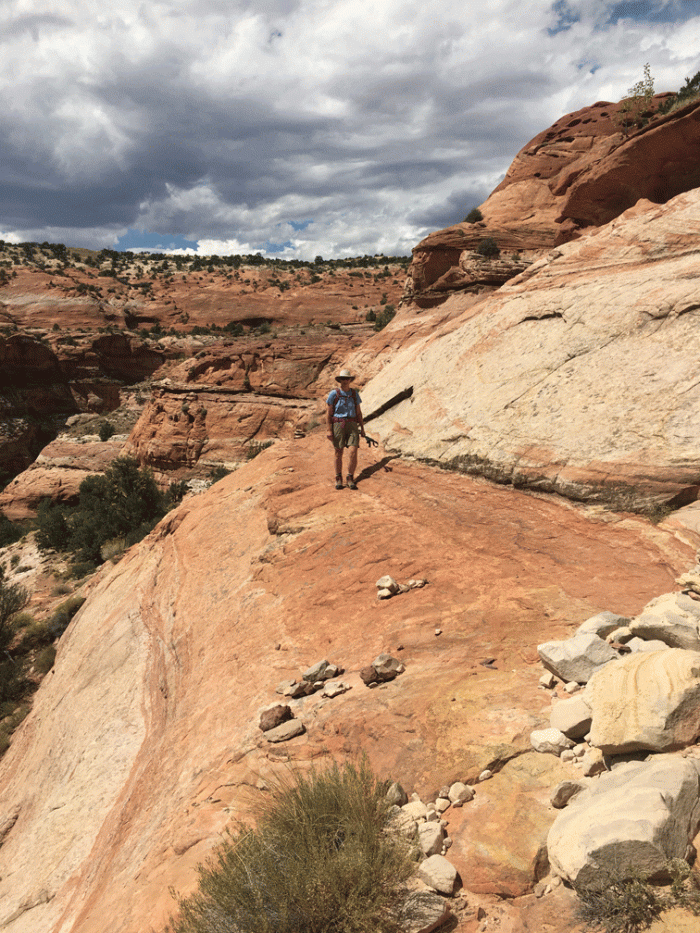
We did two hikes and a bike ride in the final week of our trip this spring. A cold front moved in as we were leaving Mesa Verde, so we chose to stay in Blanding rather than camp off-grid. Our first hike was at Natural Bridges National Monument, less than an hour drive from our RV park. The bridges were discovered in 1883 and proclaimed a National Monument in 1908, creating Utah’s first National Park system area. They are also part of the larger Cedar Mesa area. There is a paved scenic drive that allows easy access to the three bridges, and most people view the bridges from the overlooks or wander down the short trails to the base of each bridge. We wanted to travel the “unmaintained” trail from the first bridge (Sipapu) to the middle bridge (Kachina). We took the advice of the ranger and parked our truck at the Kachina Bridge Overlook and walked about an hour on the mesa trail to the trailhead for Sipapu bridge. The feature photo of this blog (on the website) is a slick rock portion of the mesa trail. Here’s a photo of the beginning of the descent into the canyon.Canyon_overlook

We worked our way down the trail, down steps, both metal and cut into the rock, and down wooden ladders to the base of Sipapu Bridge.

We had the trail to ourselves within five minutes along the canyon trail to the next bridge. The only other hiker we met was a ranger, until we got to the base of the Kachina Bridge. The photo on the left is the trail in the canyon. The photo on the right is taken below Kachina Bridge, a much thicker and younger bridge than Sipapu.

The trail up out of the canyon was well-graded and with not much effort, we were back at parking area at the mesa level. Our leisurely hike took us about four hours.

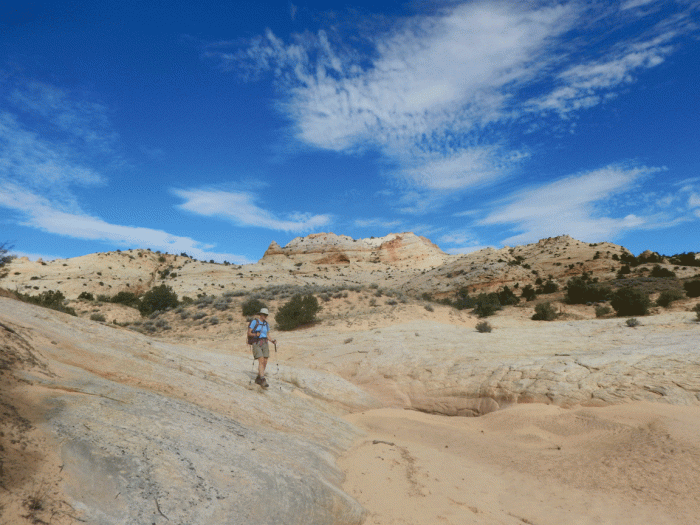
For our next adventure, we wanted to go back to a hike we did the first year that we came to Utah. It was our first foray up slickrock by ourselves, following written descriptions of the route. Back then, we got off route, following cairns that were leading us away from our destination. We poked around and found a way up that worked for us. When we set off this time, we wondered if we would find our old route or if the “standard” route would be more appealing. We had no trouble following our old route, and within 45 minutes we were at the “Procession Panel,” a petroglyph panel of 179 figures in a procession (we didn’t count them, but that’s what the guidebooks say.)

ProcessionPanel

We ascended slightly higher, to the crest of Comb Ridge, for an amazing panoramic view.

We wanted to get one last mountain bike ride in before heading home, so we packed up and drove north and northwest, through Moab and Green River towards Price, turning south to Huntington State Park. The park was almost deserted because it was mid-week, but the park warden was telling us that the day-parking lot fills up by 10:00 on a nice weekend. It’s a great place to stay, with lots of trees and open lawns, as well as good birding opportunities.

WendyHuntington

Our biking destination was less than an hour away, by highway to Castledale, then by good gravel road to “The Wedge.” It’s here that the San Rafael River has cut a huge canyon, known as “The Little Grand Canyon.” The Wedge Recreation Area features a mountain bike route that travels along the edge of the main canyon, along to a side canyon – the Goodwater, hence the name, “Goodwater Rim.” We rode about fifteen kilometres on the single-track winding trail, often just a few metres from the edge, before heading over to the main road for the ride back to the truck. We were on our bikes for about two hours.

Here’s a few photos of Doug on the Goodwater Rim Trail.

Here’s one of Wendy, closer to the edge than she thought was possible.

GW-Wendy-back-view

We took another couple of days to get all the way home. Now at home, the spectacular red rocks that we enjoyed so much throughout our seven week trip have been replaced with the gorgeous green of spring in the Rockies. “The Fox” is being cleaned and put away until the next trip. So long until then.


Mesa Verde and Huevos Rancheros

Mesa Verde and Huevos Rancheros

We chose to stay at the Mesa Verde RV Resort that is just outside the national park and half way between Cortez and Mancos, Colorado. The Whethams joined us in our adventures here. The RV park had plenty of grass for Tali and plenty of birds to enjoy.

We wanted Gretchen and Bob to experience the thrill of riding the “Rib Cage” at Phil’s World, a mountain biking trail system only minutes from our RV site, so that was first on our agenda. The trail we took climbs gradually up two washes and up to a ridge-top where a cow-skull is the focal point of a bicycle art display. The “Rib Cage” is a series of descending whoops that start off intensely and mellow as you continue downhill.

We rode in the morning, regrouped at lunch and headed up to Mesa Verde National Park for a hike on the “Knife-edge Trail,” a trail that follows the old roadbed to some fantastic views of the valley below. We had a great time looking at the birds as we wandered: turkey vultures nesting, a golden eagle being chased away, a black-throated gray warbler, some towhee or sparrow scratching in the undergrowth and the continual song of a few yellow-rumped warblers that wouldn’t show themselves.

The next day was our tour of “The Balcony House” in Mesa Verde National Park. The Balcony House is the most strenuous tour that the National Park puts on because it includes climbing ladders and squeezing through tunnels. Doug was a bit concerned about going through the tunnel on his knees, but he managed to “bear walk” through the tight bit. The guide was really good at answering questions, so it didn’t seem scripted.

After the tour, we had our lunch at a picnic site, where a pair of white-breasted nuthatches visited us. No-one had a camera ready; we will just have to remember them in our minds.

We then headed over to the Museum and Ranger station, then to a short hike to “Pictograph Point.” We chose to go down into the canyon and across to the petroglyphs (yes, the trail was misnamed), and then back over the mesa to a good view of Spruce House. (Another misnaming; there are Douglas Fir around the ruins, not spruce.)

The weather was deteriorating so we chose to do a road trip to Durango, with a stop in Mancos (10 mins. away). We had breakfast at a funky bakery/restaurant called “Absolute Bakery,” that we had heard about from a woman that we met in the parking lot of the bike trails in Fruita. Doug and Bob distinguished themselves by making it through their huge orders of “Huevos Rancheros.” In Durango, Bob looked at trains, Wendy and Gretchen looked at fabric and Doug visited three brewpubs (with company.) Wendy, Gretchen and Bob also fitted in some bird-watching while Doug was checking on a problem with the truck (not serious). The photos below are of our breakfast in Mancos and a shot that Gretchen took of the Durango-Silverton narrow-gauge train (with Wendy’s phone, just steps from the quilt shop).

The weather improved for our last day together, so we drove out to Hovenweep National Monument, about an hour drive from our RV park. It’s an enjoyable hike around the canyon viewing the spectacular ruins and worth the second trip for us. To top off the experience, there were also some interesting birds. Below is a picture of Gretchen and Wendy with the Square Tower to their right and the Hovenweep Castle behind them. The feature photo of this blog is of Hovenweep Castle.

Wendy_Gretchen

Here’s a couple of photos of birds we saw; a Bewick’s wren and a Common raven preparing dinner for the young ones that we saw in the nest just below the cliff top.

Only one more post, then our spring trip south is complete.

Fruita with Friends and Family

Fruita with Friends and Family

We organized a group trip to Fruita to bring together people from Cranbrook and those who used to live in Cranbrook. We also invited our kids. So there were eleven people in our group campsite at James M. Robb Colorado River State Park (Fruita Section). Wendy, Doug, Melissa and Andrew, Sarah; Gretchen and Bob; Melissa and Dave; Janice and Jamie.

Melissa, Andrew and Sarah from the coast came a day early, so we headed off to an easy hike in the Colorado National Monument to introduce them to the southwest landscape. They were like kids in a candy store; excited about every turn in the trail.

Kid's-playing

After exploring Devil’s Kitchen, we wandered up No Thoroughfare Canyon. Last year when we were here, we saw Collared Lizards so we hoped we could replicate the experience. We stopped for lunch just as we reached the water. (Just after the first photo below). Sarah wandered off to get a better photo of a flower and noticed a small collared lizard. We all came to look. It must have been the “Time Lizards Come Out to Sun Themselves,” because we saw another and another. The second photo below is just the best one of dozens.

Then we drove up Rimrock Drive through the Monument and stopped at most of the lookouts. Here’s a photo of Andrew at the “Cold Shivers Lookout”. Wendy actually had  shivers standing beside the fence overlooking the view, while Andrew seemed quite comfortable perched on a toadstool a long ways outside the barrier.

Andrew_Shivers

The next day, all eleven group-members headed out to the bike trails at Road 18. The trails are perched on the slopes below the Book Cliffs. There was a single up-track leading to multiple flowing descents. The first photo is Melissa with Gretchen following. The next one is of Doug on “PBR.”

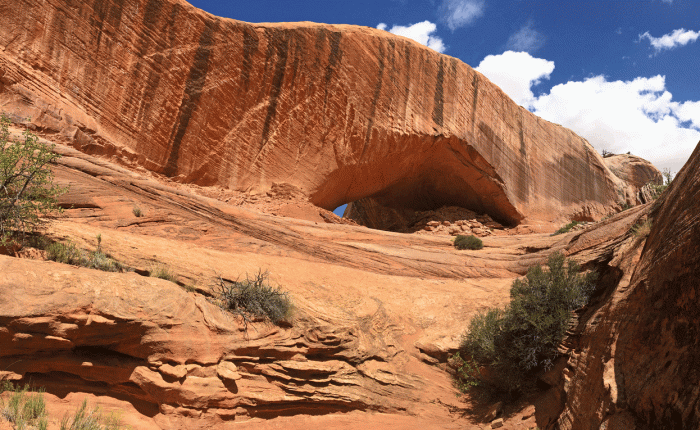
The next day was a hike to Rattlesnake Canyon, part of the McInnis Canyons National Conservation Area. We had read that it was the second highest concentration of arches outside of Arches National Park. But the steep, rough approach was definitely not a National Parks standard road. After driving a little less than two hours, we were ready to start hiking. As we descended the trail, we could see across the river to the highway and to the bike trails that we were planning to ride the next day, which seemed weird because of our long approach. When we turned the corner into the canyon proper, it seemed that there were arches around every bend.

Because there were so many photographers in the group, the Hogg family thought it would be good to get a group picture. When we saw the unique cliff indentations, we thought it was a perfect spot for a photo shoot. Below is one of the images of “Hoggs in Holes” and a picture of the photographers.

We got to the end of the trail after two and a half hours of leisurely walking and viewed “First Arch.” Here is where the standard trail ended. The route up the sandstone and under the arch looked inviting to some of the party. Maybe for another time. We were back at the trucks after the climb up in about two hours. The younger members of the group took the side trip on the way back to look at “First Arch” from above.

First-Arch

The next day was a biking day for all the Hoggs and Andrew and Gretchen. We went to the Kokapelli Loop trails, just a few miles down the highway from our campsite. We all enjoyed the warm-up loop called “Rustler’s.” Here’s a photo of Doug on one of the smooth sections and a photo of Sarah, Melissa, and Andrew at a river overlook on the trail.

Everyone was feeling good, so we headed out for more. Wendy had seen the Horsethief Bench the year before and wanted to give it a go. The parts of the trail you could see from above looked nice, and they were. There were other sections that were more difficult, starting with the descent down to the bench. It was definitely a “hike-a-bike” section. You can see Andrew carrying Wendy’s bike and Sarah carrying Gretchen’s in the photo below. How Wendy and Gretchen got their bikes up when the kids went on ahead is another story, best told in person.

Route-to-Horsethief

Here is Sarah showing us good mountain bike technique on a slickrock feature and also on the trail.

Here’s Wendy on one of the enjoyable sections through a wash.

Wendy-in-wash

On the final day, one group started at the bottom of the Monument trail, the other at the top. They met for lunch part way along, then each group drove the other vehicle home to camp. The “feature” photo of the blog (you need to go to the website to see it) is the view the “up” group saw as they made the 1000-foot ascent.

Fruita is a great town (pop. 12,600) that embraces the mountain biking and outdoor community. A lot of their downtown art has a biking theme. Here are Andrew, Melissa and Sarah on a huge old-fashioned bicycle. I’m sure we’ll be back.

Downtown-Fruita.gif

Monument Valley and area

Monument Valley and area

Monument Valley straddles the Arizona/Utah border and was intriguing to us. We had seen the impressive buttes and mesas from a distance and were interested in seeing them up close. We booked a space in Goulding’s RV park. The Gouldings established a trading post in the area in the 1920s and were instrumental in introducing the world to the spectacular scenery that was used as a backdrop to numerous Hollywood movies beginning with the John Wayne westerns.

The campsite is surrounded by redrock. They even have their own “Hidden Arch” that we hiked to the day we arrived. Look closely for our Arctic Fox in the second image.

To see the rest of Monument Valley, one needs to pay a fee to enter the Navaho Tribal Park. Most people drive the seventeen-mile rough road to various scenic outlooks or join a guided tour. We chose to do a two-hour hike first, then drive.

The hike was around the West Mitten, a butte that is shaped like a hand. When you get around to the other side of the butte, you have a view that isn’t seen by most people. It was an easy and enjoyable hike.

Here’s a view from one of the scenic overlooks on the drive.

Valley_view

The next day, we drove north about twenty minutes to Goosenecks State Park, a spot we had camped at on our first trip to Utah. We continue to be awed by the magnificent view of the San Juan River far below. While we were there, a group of canoeists floated by.

Goosenecks_pano

Just minutes north of the state park, is the Valley of the Gods, a kind of “mini” Monument Valley. The buttes in this area are formed from an older geologic layer than their larger cousins, but are just as interesting. They have names such as “Laying Hen” and “The Lady in the Bathtub” but a person could see other shapes as well. We went for a short walk and had our lunch.

VOG_scenic

It was still early in the day, so we checked our GPS and realized that in about half an hour we could be at the trailhead for a hike to a petroglyph panel that we’d always wanted to see. Luckily, we had a guidebook and hiking boots in the truck. With Wendy’s binocular case repurposed as a water bottle carrier, we were set. The hike to the panel was uneventful, or so Wendy thought, until she was preparing the blog post and Doug showed her the photo of the “Midget Faded Rattlesnake” that scampered across the trail in front of him, just below the petroglyphs.

Here are some images of the “Wolfman Panel.” If you look closely, you can see the depth of the carvings. It’s hard to imagine how the highest petroglyphs were made. Researchers figure these were created about a thousand years ago, but no-one really knows what they mean.

If you are following us in real time, you can tell that are posts are delayed a week or so. Perhaps we’ll catch up before we get home.

Return to Zion

Return to Zion

Doug came to the Zion National Park area with a tick list of rides and a hike that he wished he could do when we were here last year, but his knee wouldn’t let him.

First up, was riding the JEM trail. If you were following our blog last year, that’s the trail that Wendy rode and Doug followed in the truck on nearby roads. The day we chose to ride, started off with a few rain sprinkles, so we waited until any sign of precipitation passed and the trails were dry. It’s not that we’re afraid of getting wet, it’s just that a bike can ruin the muddy trails and the clay trail surface turns to mud with just a bit of rain. So after lunch, we headed out to the trailhead, a short drive from the RV park. Dozens of runners were coming up the road as we neared the parking spot. They looked like they had been running a long time. Turns out, some of them were in a 100 km race that had started the day before. Others were doing marathons or half marathons. And part of their race was on the same trail that we planned to ride up. Doug was pretty committed to this ride, so we hoped that they wouldn’t be running our whole route and started up the trail. In the first half hour, we didn’t ride for more than a few minutes before stopping to let the runners past. The trail at this point was narrow along the edge of a canyon. Luckily, the race route varied from our chosen track and we had an enjoyable hour of riding gradually upwards with some nice loopy bits before heading down. We only encountered a few runners on our way down and we were able to pass them easily.

WendyJEM

Next was a longer hike in Zion National Park: to Observation Point. It’s eight miles return and 2000 feet elevation gain. It starts off going steadily up and up and up with a little bit of gradual up, followed by more up and up. There’s a mile or so of almost flat walking once you reach the elevation of the point. It took us about two hours to reach our early lunch spot at Observation Point. There are great views all the way down the canyon (which might be obvious from its name). And then the down… and down… and down, which seemed to our old joints to be harder than the up. But it was well worth it. We started out early enough to have lots of room to ourselves on the way up in the shade and had a silent chuckle at the crowds climbing up in the full sun.

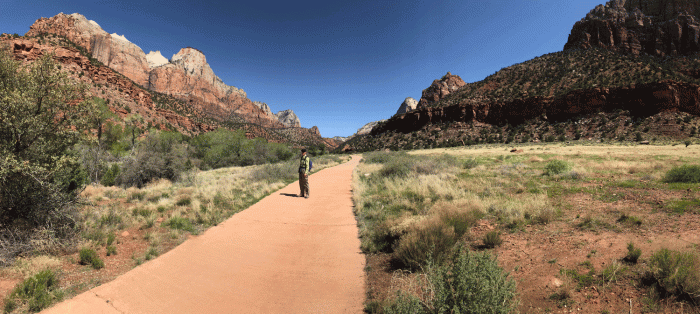
After those two days, we needed a rest day, so decided to stroll the Riverside Walk and look for birds. It was a chilly morning; Wendy had on five layers and a hat and gloves. The birding was slow; we saw a very loud house wren at the start of the trail, a few American Dippers along the water’s edge and some American Robins. We walked the entire trail to the end of the pavement to where, in lower water, people could continue up the canyon, mostly walking in the water.

We felt like we’d seen everything there was to see and were heading back when Wendy heard a small chirp and looking up, saw a flash of red. Could it be a Painted Redstart? We had heard that they had been seen on this path a couple of times this year, but they’re pretty rare. The mainly black bird with a bright red belly stopped long enough for us make a positive ID and take a few photos before it disappeared. A few minutes later, three Painted Redstarts were flitting and chasing each other before one perched even closer this time. And then they were gone. While we were watching them we stood off the trail and dozens of people walked by us. No one seemed to care what we were looking at or how lucky we were to have seen these beautiful (and pretty rare) birds.

Redstart

Now we headed back thinking about where we might have lunch, when another call stopped us and made us look across the river. Oh a Black Phoebe! (A bird that we didn’t know existed until we saw it last week in Nevada) We enjoyed another few minutes of viewing and picture taking before it flew away. Now are birding excursion was truly complete.

The last thing on Doug’s list was to ride at Gooseberry Mesa, a mesa we could see from the RV park. To get there, we drove through Hurricane, up the road past the top of the JEM trails and into the Apple Valley, then up a dirt road to the mesa.

We rode along slick rock as well as dirt roads to get to the point, then came along the north rim for the return journey. Wendy is looking towards our RV site with Zion National Park in the distance.

GooseberryPano


Hiking, Birding and Biking in Nevada

Hiking, Birding and Biking in Nevada

We came to the southeast corner of Nevada with plans to visit the Valley of Fire State Park. Friends had recommended that it was a “must see.” Doug found an RV park within 20 minutes of the VoF at Echo Bay on Lake Mead. Echo Bay has seen better days. Lake Mead is currently about 140 feet below full pool, which makes the RV park and any amenities a long, long way from the water. The marina closed in 2013. There’s a boat launch, but it isn’t busy. The Echo Bay RV park worked out well for us, because the sites were huge and most were vacant. We could even do some birding from our chairs.

The Valley of Fire State Park was beautiful, with lots of red rock canyons with some white rocks for variety. The park focuses on the typical tourist from Las Vegas with lots of short hikes from different parking lots. (Las Vegas is only an hour away.) The crowds really thinned if you got more than 20 minutes from the vehicle, so we had some space to ourselves. We basically covered every hike and viewpoint in the two days that we visited.

They call the feature on the left, The Fire Wave. It was about a half hour hike from the parking lot. We went a bit past the official trail to find the arch in the photo on the right. Doug did a short bit of scrambling to stand under it.

The prickly pear cactus were in full bloom, and Doug had a hard time walking past one without taking a picture. He took dozens photos.

We also encountered a new lizard for us: a chuckwalla. These interesting creatures have a unique defense mechanism. They crawl into a crack and inflate their bellies so they can’t be extracted. Here are photos of two that we saw; the bigger one was about 40 cm long and the smaller one was about 20 cm.

We were pleasantly surprised by the birding in the area. Some birders that we met when we were in St. George told us about a unique bird viewing preserve in Henderson, NV about an hour drive from our RV park. Henderson uses reclaimed water for irrigation as well as for the nine ponds in the bird viewing preserve. People come from all over the world to see the huge variety of birds that are often at the preserve. We saw 32 species that day, ten new birds for me, including a Costa Hummingbird that was sitting on her nest in the tree just outside the front door. They had a scope set up so anyone could have a peep.

Here are some shots of shorebirds that we saw in one of the ponds. The Black necked stilt has red legs and the other one with the yellow legs is a Lesser Yellowlegs.

On another day, we went about a half hour north to the Overton Wildlife Management Area. This area is for bird viewing as well as hunting. During hunting season, the days alternate between hunting and viewing. When we were there, it was wild turkey season, so some of the fields were closed to us. We did see a couple of wild turkeys that wandered outside of the main hunting fields. They looked funny with just their heads bobbing above the lush green of the irrigated field. So the birds here were pretty flighty. We had to sneak up on the Great Egrets and Doug was able to catch one flying away with his camera. We saw 25 species that day, including a Lucy’s warbler that happened to be at the edge of the picnic area during our lunch break.

GreatEgret

Echo Bay is also within an hour of the Hoover Dam. Another pleasant surprise was that there was a Historical Railroad trail that you could walk or ride from Boulder to the Hoover Dam. So, one day we rode our bikes through the five tunnels. It was about 11 km return on a hard packed crush surface. When we got to the dam area, we locked our bikes and walked with the tourist hordes up to and over to connector bridge to take the requisite photo overlooking the dam. It was an easy and fun way to see the dam and also to get great views of Lake Mead.

We’re now half way through our week in the Zion National Park area. We’ve been so busy that our posts are delayed… but we’re on vacation. Next post will be whenever we can slow down long enough to put it together!
South to St. George, Utah

South to St. George, Utah

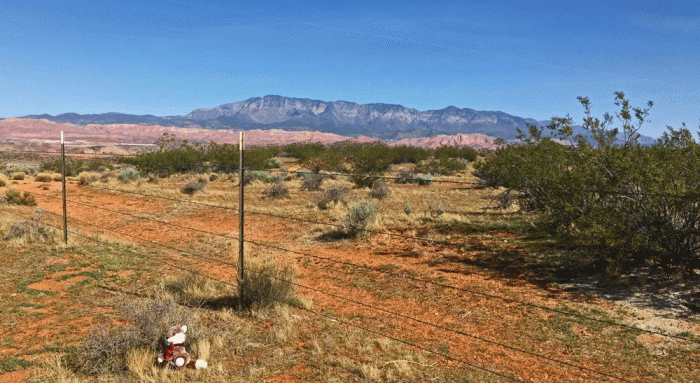
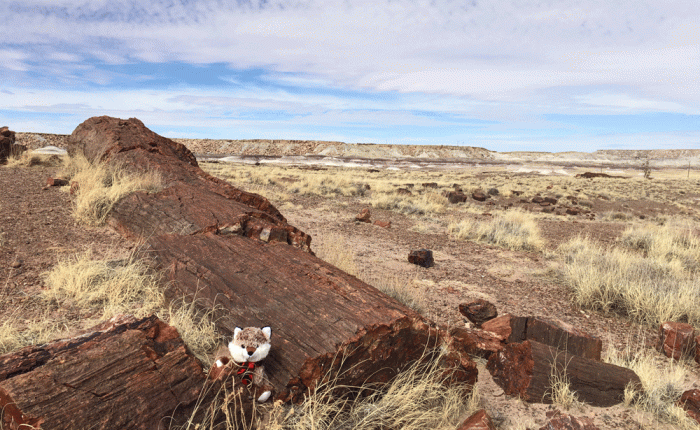
Snow in the forecast for Ruby Mountains, our planned destination. Sun for St. George so it was a no brainer – go south. We still had a couple of days with rain and a couple of days that had wind, but it was much better weather than the rest of Utah.

Doug made a booking at an RV park right in St. George. They didn’t have room for us in the regular park so we agreed to go in their “storage” area for two nights, with electric and water hook-ups. Tali wasn’t so thrilled with the gravel surface, especially since there were no other dog smells. The good point was that our neighbours were very quiet. (They were empty units.) The whole park looked a lot better on the internet than in real life, so we cancelled the rest of our booking and looked for a better place.

Here’s a photo of Wendy taken from Pioneer Park, on a ridge full of sandstone bluffs, perfect for kids to scramble on. In the background is downtown St. George, with our first RV park somewhere in the distance.

Pioneer-Park_Wendy

We relocated to the KOA, about a half hour east of St. George, which turned out to be a perfect location for us – right across from Red Rocks Recreation Area (hiking and biking) and a few minutes from Quail Creek State Park (birding).

We hiked in Snow Canyon State Park on three different days. The first day was unsettled, but we got in a short walk to some lava tubes before it rained.

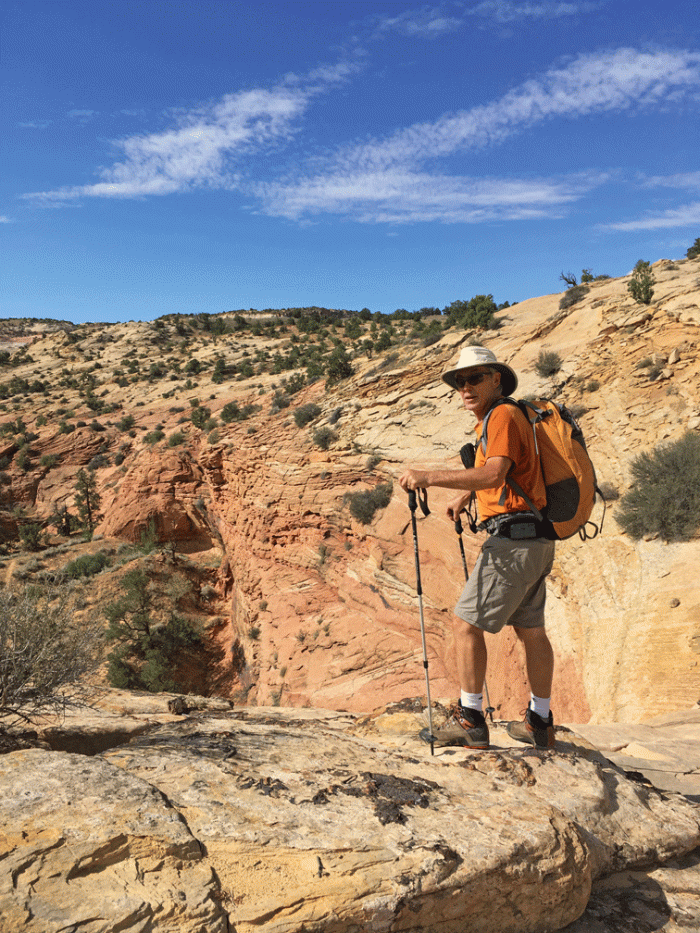
We chose to explore the White Rocks area on another day. We hiked about half an hour to a natural amphitheatre. It was so windy we were almost blown off our feet. Doug noticed a canyon that looked like we could follow down to another trail. It was mostly walking, with a bit of scrambling, and it was out of the wind. Although the route wasn’t well travelled we could tell that others had used it.

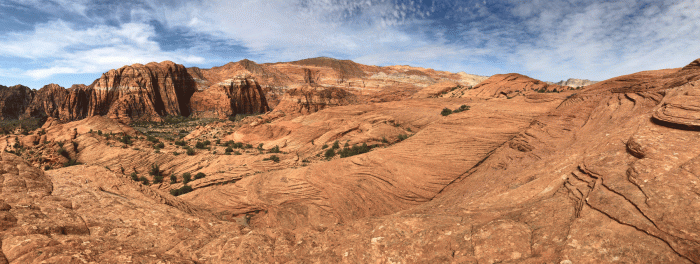
Here is a photo after we got out of the canyon. You can see the “V” to the right of Doug.

Doug_pano

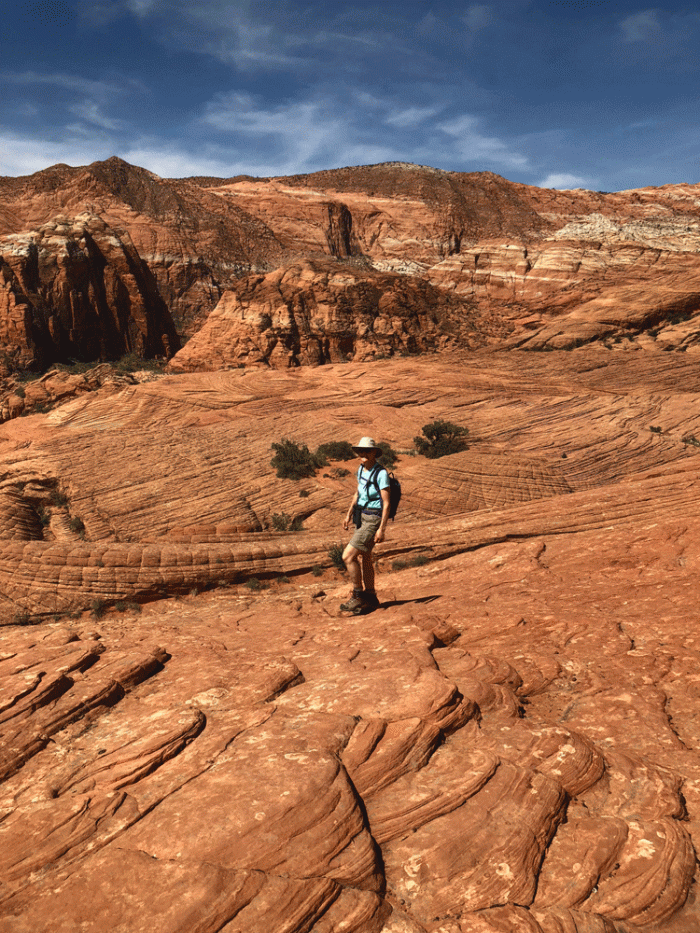
We had perfect weather on the third day at Snow Canyon. The park is set up for people to take short loop hikes from different parking areas. We connected short trails to make a longer loop to make it a three and a half hour hike. The photo on the right shows Doug on the “Petrified Dunes” section.

We scrambled up an overlook for a quiet lunch in the shade. From there we could see our descent route and the trail back to the truck.

Wendy-ledge

Doug was really happy to be able to get back on his bike in the outdoors. Our first warm-up rides were on the beautiful paved trails in St. George. Riding on trails came back to him easily. We also rode the trails in the Red Rocks Recreation area that were really close to our second campsite. The trailhead to the White Rim trail (photo below) was five minutes from our trailer.

Doug’s longest ride was the Church Rocks loop and back to the trailer for a 18 km trip. We loaded his bike in the truck for a different access to the Red Rock Recreation trails. Wendy drove the truck back to camp and did some birding on the way back.

Bike_Church-Rocks

We’ve now set up our base camp at Echo Bay, Lake Mead, Nevada for our next birding, hiking and biking adventures.