Having Fun around Page, Arizona

Having Fun around Page, Arizona

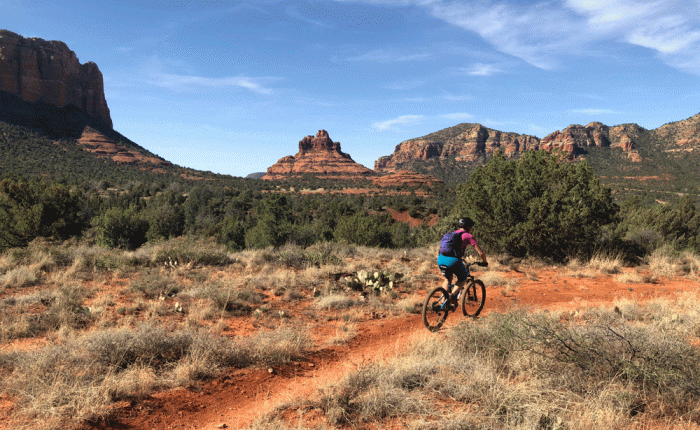
We found lots of things to do around Page, Arizona, and one of them was literally around Page. Page is situated up on a mesa and has a trail that circles the rim. We rode the ten mile (16 km) trail two times in our eight day stay. At one place the trail went between the fairways of the golf course and we had a very short section on pavement. Mostly the trail was on slick rock or rocky trail. We had good views of the Glen Canyon Dam and Lake Powell.

Here’s a photo of the Glen Canyon Dam from another day.

GlenDam

We stayed at Wahweap campground that is in the Glen Canyon Recreation Area. We had spectacular views from our spacious site.

Rainbow Bridge is an impressive natural bridge that can only be reached by boat or an overnight backpack of more than 20 miles. Since our long backpacking days are over, we opted for the boat. We sat on the open top deck for the hour and a half cruise, wearing plenty of layers in the morning chilly wind. When we got off the boat at the floating dock near Rainbow Bridge, we converted our pants to shorts by unzipping the legs and hiked the mile to the bridge in the baking hot sun.

Here are two views of Rainbow Bridge; the first one is as you approach it, and the second is from behind. We took a trail around to the other side of the bridge; no one is allowed to walk under the bridge since many of the indigenous people of the area consider it sacred.

The cruise through Lake Powell was also impressive: clear water, blue skies, red sandstone cliffs. The white “bathtub ring” on the rock shows Lake Powell’s highest level back in the early 80s.

BoatWake

Our daughter and her husband joined us for a few days. We booked a tour to Canyon X in Antelope Canyon. The tour group is relatively new, so it was easier to get a booking. It seems that most tourists come to Page for just a few days to see Antelope Canyon. The tour was relaxed and our guide was personable. We got some amazing photos. Here are just a couple.

Our tour was an hour and a half, so we wanted to fill the day. Next on the tourist tick list is Horseshoe Bend on the Colorado River. It’s a 15-minute walk from the parking lot on the side of the main highway south of Page.HorseshoeBend

To get a good view of the river, you need to get quite close to the huge drop-off, which wasn’t a problem for the young people. We saw recent construction of a viewing platform with a wire security fence. Hopefully a person will still be able to climb out on the rocks if they choose when the project is complete.

For the afternoon, we drove north into Utah and visited the toadstools. There’s a rough path up to the main group of toadstools. We then wandered around and worked our way back to the parking lot.

Wendy_hoodoos

The next day, we drove back into Utah to Wire Pass trail. The trail follows a wash, goes through a slot canyon and joins Buckskin Gulch. We walked both directions in Buckskin Gulch until the water was too deep.

A short hike right in Page is to the “Hanging Garden.” Water seeps from between the sandstone layers and provides an environment for maidenhair ferns. It’s quite a contrast from the dry rocky terrain just metres away.

Yellow Rock is a favourite place, so we wanted to return. Back in 2015, Wendy hiked up with her quilt in the bottom of her backpack for a photo shoot. The patterns and colour in the rock fascinate us.

The hike to Yellow Rock was short, so we combined it with walking into Lower Hackberry canyon. We changed into our water shoes and enjoyed the cool water and shade.

We did get a little bit of birding done as well. This loggerhead shrike posed on the fence beside a road we were exploring. Our campsite seemed to be one of the best spots. Yellow-rumped warblers flittered in the tree, but their quickness and the leaves made it difficult to get a good photo.

We enjoyed our visit to Page, and there are still interesting things that we missed doing. Next stop is in the Sedona area.

St. George area: hiking, biking, birding, relaxing

St. George area: hiking, biking, birding, relaxing

When we were in the St. George area last year, we checked out Sand Hollow State Park, which is about a half an hour southeast of St. George. We made reservations in December for a full service site on the outside of the loop. The site (#18) was ideal for us, with a view of the lake (reservoir) on one side and a panorama of mountains on the other. The sites are also well spaced out.

Campsite

ReddyFox

Nearby to our campsite was a slickrock area known as “the jumping rocks.” The first day we walked there it was cooler than the next Saturday that was full of people, with teenagers jumping off the rocks into the chilly water.

We hiked at Snow Canyon State Park, which is nine miles north of St. George. No chance of snow here; it was named for Lorenzo and Erastus Snow, prominent pioneers. We love the spectacular scenery, especially in the area known as the “Petrified Dunes.”

Wendy_sand-dune

Snow-Canyon_pano2


We had a couple of good days biking as well. First we rode at the JEM trail area just above Hurricane. The JEM trail from the lower parking area winds its way up on the edge of a canyon then climbs steadily up through the desert brush environment. It was a fun flowy ride down.

We also rode the Church Rocks loop, which is in the Red Cliffs National Conservation Area. We accessed it from a new highway interchange at Washington Boulevard (Grapevine to Prospector’s to Church Rock loop). Prospector’s has a steep “hike-a-bike” section, but otherwise we were pretty much able to ride everything. If you look at the photos below, the trail is along the top of the rock behind Wendy.


We also had time for some birding. We found a great spot in the Red Cliffs Recreation Area, right around the Orson Adams house (a pioneer family of the area). Quail Creek runs right by the house which is a draw for the birds. The cottonwood trees had verdins and yellow-rumped warblers. White crowned sparrows foraged below the scrubby bushes, and a black phobe enjoyed the water’s edge. There is also a good view of the red cliffs.

Wendy_bino

Being so close to Zion National Park, we just had to go again. We chose to do some birding along the Riverside Walk. Most of the people on our early bus got off before the last stop at the Temple of Sinawava. The 2.2 mile trail is mostly in the shade, so we were well bundled up. We got a good look at some Common Mergansers. A house wren was singing loudly, a posed for enough time for a photo.

On our way back to the Visitor Centre, we chose to get off the bus at the highway intersection (Canyon Junction) and walk back via the Pa’rus trail (1.7 miles). The paved trail follows the Virgin River and allows good views of the Towers of the Virgin.

Zion_pano

Zion_pano2

From one of the pedestrian bridges, we watched a couple of black phobes catching insects.

Phobe

As we got closer to the campground, the birds were more plentiful. There were lots of western bluebirds and yellow-rumped warblers.

We stayed at Sand Hollow for eight nights. Two bike rides, two hikes and a morning of birding, which means we also had time to relax, read, and Wendy had some time for quilting. We’re learning to slow down a bit and enjoy our time in “Big Red.”


The land of the cactus

The land of the cactus

We planned our trip to Mesa, Arizona to coincide with a quilt show, and choose the RV park because friends were staying there for the winter. We first thought we would be lazing by the pool most of the day enjoying the warm weather. After some research, we realized there was hiking and mountain biking in the nearby mountains, so although we sat by the pool everyday, we were also very active.

We stayed at Mesa Regal, a RV resort of over 2000 units. Many of the spaces are filled with park model mobile homes with attached “Arizona rooms,” with some spaces for coaches and fifth-wheels. Most residents stay for six months or more, but they have room for short-term visitors as well. Once we navigated the narrow roads and were backed into our site, we were glad we were staying put for a while. The park was a full-scale resort, with large pools in two locations, a restaurant and bar, tennis club, and various activity rooms including a quilting room. It was a very active 55+ community with a full schedule of activities to partake in. We enjoyed sitting by the pool, and if we had been there longer, Wendy would have joined the quilt group that has over 150 members.

The Arizona Quilters Guild annual show “Quilt Arizona!” was at the Mesa Convention Centre, about a 20 minute drive from the RV resort. Wendy was there most of one day; taking in a lecture and having fun perusing the various merchant tables for interesting products and bargains. The quilt below didn’t win any awards, but it is a good example of a quilt in southwest colours. (Finding Turquoise in the Desert by M. Nowacki).

We bought the warthog-like sculpture, (maybe it is a javelina?) at the Mesa Marketplace Swap Meet, which is less of a swap meet nowadays and more of an open-air market with about 900 merchants. It was a “recreational shopping” experience.

There was a great birding area within 15 minutes of our RV park: The Riparian Preserve at Gilbert Water Ranch. Any water in the desert brings birds, and we had a productive morning observing forty-one species, including three that were new to us. Doug got a good photo of a Curve-billed thrasher on its nest in the Sagura cactus. The cacti grove (if you can call it a grove) was at the entrance to the riparian preserve.

We saw more cacti on our hikes. We hiked to the ridge above the popular Wind Cave in Usery Mountain State Park.

The Saguaros were also magnificent on the “Hieroglyphics trail.” The easy trail led to ancient Anasazi petroglyphs (erroneously named hieroglyphics). The feature photo on this blog (you’ll see it if you view the blog on your browser) is a view of the Superstition Mountains taken from the trail.
Petroglyh_hike

We also rode our mountain bikes through the cacti on the Hawes loop. Luckily the trail was wide enough that we didn’t get too close to any thorns. The trail was really nice, not very sandy or rocky.

Our next stop was to Boulder City, Nevada. It turned out that there was another quilt show nearby! The Desert Quilters hosted their annual quilt show, “Quilt Las Vegas” in the Henderson Convention Centre, about a half hour from the Canyon Trail RV park where we were staying. So, our morning started with a short mountain bike ride on the Bootleg Canyon trails that we rode to right from our trailer. A quick shower, and Doug dropped Wendy off at the quilt show. There were many amazing quilts, but we chose to post a picture of a “Leaf Me alone to Quilt” because the maker (M. McNelley) had bought the pattern on her trip to Canada.
To top off the day, we saw a sign for a beer festival; so we had to check it out. It was in the city park in the middle of Boulder City. There was a live band, and beer tasting tents and food trucks ringed the park. The photo below shows only a small section of the crowd. Doug enjoyed his sample of amber ale from “Rickety Cricket” a brewery out of Kingman, AZ.

We were also only minutes away from the Henderson Bird Viewing Preserve. (You can check out our post from April 2017 to see our photos from our visit last year.) This year, we saw the same number of species (31), although there were differences. We saw our first Black-crowned night heron. It is a stocky, large-headed heron that rarely extends its neck. The Yellow-headed blackbirds were loud and showing off.

We also got a good look at a family of Double-crested cormorants.

And of course, we had to visit our favourite Nevada brew-pub, Boulder Dam Brewing. It’s a block away from this eclectic antique shop.

Boulder_storefront

Next stop: St. George area, Utah.

Petrified Forest National Park and area

Petrified Forest National Park and area

Petrified Forest National Park is a day’s drive from Fruita, Colorado en route to Mesa, Arizona. We stayed in the closest campground in Holbrook, Arizona.

We set out the next day for the park. We started at the northern end of the park, which encompasses the “Painted Desert.” The long views were so amazing that it was hard to capture them in a photograph.
PaintedDesert

Here’s a view from a trail below the Blue Mesa. Petrified wood lay scattered around everywhere.

Petrifed-Forest-NP

Some of the petrified logs looked as if they had been spilt for firewood. The signposts explained it well. Think of the petrified wood as a piece of chalk; under pressure, it splits across the grain as if it was cut by a saw.

We’ve seen some good examples of petrified wood over the years; some involving long hikes in remote areas, but no other place had as much petrified wood as in the Petrified Forest National Park. It was all around; huge logs exposed to the elements. The variety of colours depended on the minerals present when the wood changed to stone.

Wendy couldn’t decide which was her favourite log; each had a different variation of colour. The old Route 66 cut through the park, and a rusty old car was appropriately placed (it was hard to believe that it actually died there), but it called for a photo.

We were also close to the “Meteor Crater,” so the next day, we decided to have a look. Although it has been declared a “natural landmark,” it is privately owned, and has been turned into a tourist destination, complete with admission fee, museum, tours and the quintessential gift shop (which you need to walk through to access the washrooms.) The crater itself was impressive and the museum was very informative.

Wendy_meteor

Yes, we had to admit, we were tourists, because nearby was Winslow, Arizona and we had to go. Even before Doug knew there was a park commemorating the lyrics in “Take it Easy” he was interested in visiting Winslow. “Standin on the corner in Winslow, Arizona, Such a fine sight to see, It’s a girl my lord, in a flat deck Ford, slowing down to have a look at me.” We like to believe that the statue is of Jackson Browne, one of our favourite singer songwriters.

We enjoyed our few days enroute to Mesa, seeing things we’d never seen before. In our next post, we travel to the land of cactus.

New Trip, New Fifth Wheel

New Trip, New Fifth Wheel

It happened. We traded in our beloved Arctic Fox trailer for a Redwood fifth wheel. Now we have more space; nothing needs to be stored under the dining room chairs and we can fit all the groceries in the bigger fridge and freezer.

As usual, our trip south this spring was planned before Christmas, with a tentative departure date based on the weather. As it worked out, we chose to leave earlier than planned in order to miss the “wintery mix” forecast. It was sunny on our first two days of travelling (to Missoula, then Idaho Falls). Clouds set in on our drive to Willard Bay, just north of Salt Lake City in Utah. It started snowing big flakes as we broke camp the next day, so it was good that Doug had driven through Salt Lake City traffic a few times before. The snow didn’t really stick to the road much and the traffic was bearable. There was a little bit of snow at Soldier Summit, but as we dropped down, the weather cleared, and the roads were bare. Unfortunately, the showers caught up to us, just as we arrived in Fruita, Colorado.
It cleared up quickly and here is a photo of our new unit at our campsite the next morning at the same state park that we have been in twice before.

Redwood

On our last blog post in October, we posted a photo of our old, blind golden retriever, Tali in front of the Carbondale city sign. Sadly, we’ve said good-bye to Tali. We’re adjusting to not having a dog after 39 years of “dogship.” So our photo of the sign at James M. Robb Colorado River State Park has a stuffed fox, instead. The fox is also helping us keep true to our “Travels with a Fox” name; the original nomenclature referred to our Arctic Fox trailer. Watch for “Reddy Fox” to appear in future blog posts.

As you can see in the robin photo below, some of the trees have just started budding.

There weren’t as many birds around as on our other trips which were later in April, but the local meadowlark was singing his heart out most of the day.

In the afternoon of the next day, it had warmed up enough for a bike ride. We went to the Kopapelli trailhead and our favorite warm-up loop, “Rustler’s Loop.” Both of us were pleased that we could ride sections that we had trouble with in previous years.

We were itching to hike in the red rocks again, so the next day we headed up Monument Canyon trail. The well-maintained trail is in the Colorado National Monument (which is like a little brother to a national park) and heads towards Independence Monument.

We reached Independence Monument in about an hour. It was too early to have lunch, so we followed a climbers’ trail around the monument. Here’s a view down toward Fruita and Grand Junction.

Wendy_hike3

Instead of retracing our tracks, we followed an “unmaintained” trail through Wedding Canyon down to the trailhead. The trail was in better shape than most of the trails that we hike in the East Kootenays and it was nice to make a loop. Here is a view looking up to the monument from the canyon.

Canyon-Pano

Sunday was a “rain day” which gave us the time to do a bit of cleaning and organizing in the fifth wheel, and for Wendy to get out her sewing machine. The quilters out there will notice that she’s not piecing, just sewing a loop on a towel, but it was a good test of the set-up. That evening we made pizza, testing out the new mini bread maker and our new oven. It was awesome!

We’re on our way to Arizona tomorrow. New blog post soon!

Maroon Bells and home

Maroon Bells and home

Our trip planning started with Doug’s desire to see the Maroon Bells, near Aspen, Colorado in fall colours. We booked a spot in the closest RV park in Carbondale, about 30 miles from Aspen, for September 28 and 29. The town owned Gateway RV Park is along the river just a short walk away from the town sign. Here’s Tali posing.

Tali

The Maroon Bells are two peaks in the Elk Mountains and are one of the most photographed mountains in the United States. They are composed of metamorphic sedimentary mudstone that gives the Bells a distinctive maroon colour. The rock is downsloping, loose, rotten and unstable, but we had no intention of doing any climbing. It’s a really popular area, since the peaks are easily viewed within a few steps of the end of the road. A bus service runs from 8 am to 5 pm from mid-June to the end of September to deal with the volume of people.

We left most of the tourists at Maroon Lake and started our hike to Crater Lake, (1.8 miles up the valley) and caught some glimpses of blue sky. The weather was unsettled, however and soon we donned our rain gear to protect us from the wind and hail.


This grey jay took advantage of a puddle on a rock to get a drink.


We reached Crater Lake in just over an hour and took more photos of the Bells.

CraterLake

On our return trip, it rained hard enough for us to take out our umbrellas, but it was short-lived. It was beautiful hiking through the aspen forest.


By the time we were back to the meadow above Maroon Lake (just a few minutes from the bus stop) the sun was shining on the aspens. Doug was satisfied that he had seen the Maroon Bells with fall colours, even though it was more crowded and less of a wilderness experience than he first envisioned.


We saw all sorts of people on the trail, some that looked like they’d hiked before and others that looked like they walked off a city street. It was a moderate trail, but was fairly high (Crater Lake was just over 10 000 feet) and the weather changed quickly. It made us wonder if the people who bought the t-shirt with the slogan, “I survived Crater Lake” bought it for a joke or because they’d had a less than enjoyable experience.

Back in Carbondale, we visited the Roaring Fork tasting room in the historic district. Doug had a Triple IPA and Wendy enjoyed their Oktoberfest ale.


The next day we headed north on the 15 to Wyoming. About nine hours from Carbondale, we were in Buffalo, Wyoming. We stayed at the aptly named “Deer Park RV park” and watched the deer nibble grass in the playground. The turkeys wandered through in the morning.


One more day got us to Missoula, then home the next day. So if you are reading this in real time, you’ll know we’ve been back for over a month. (It’s so hard to write about a vacation when we’re home.) We’ve made reservations for next spring’s trip already. So until then….

Taos and Angel Fire, New Mexico

Taos and Angel Fire, New Mexico

Our drive from Durango, Colorado to Taos, New Mexico was about five hours through rolling countryside and over the Continental Divide. We actually drove through Taos and up the Taos Canyon to Angel Fire Resort. That meant pulling the trailer through the narrowest section of the historic downtown and up the winding road, but Doug was up to the challenge and did fine. Here’s a photo of the narrow street, taken the next day.

Taos_street

The Angel Fire RV Resort is part of the Angel Fire Ski and Summer Resort and is the most impressive RV park we have ever stayed in. The large sites are paved with an expanse of grass. The clubhouse, gatehouse and bathhouse are all decorated in a western lodge style. Here are some photos of a couple of mirrors; one is in the clubhouse hallway, the other in the bathhouse lobby. The bottom photo is the fireplace in the clubhouse lobby.

We had long views to the mountains around and heard elk bugling most nights. Here’s a photo of one evening sky with billowing clouds. (No rain that night)

clouds_angelfire

The Rio Grande River Gorge near Taos flows in a rift valley. The gorge was not formed by water like many of the canyons that we have visited, but rather by two continental plates shifting. There is a beautiful bridge that spans the gorge that allowed us a brief glimpse of the gorge when we first crossed it with the trailer. We went back with just the truck to get a closer view.

The day before, we found a bike trail a little farther down the gorge appropriately called “Rift trail.” It was full of flowy dirt tracks interspersed with “not-too-rocky” downhills and wash crossings. Wendy was especially excited at being able to stay on her bike the whole route, now that her hand and concussion were fully healed and she had adapted to the altitude. The views near the edge were fantastic.

We also had to do the typical tourist stuff while in the Taos area. We visited the Taos Pueblo, the oldest continuously inhabited community in the United States. Many of the homes now operate as shops, with the shopkeepers living in regular houses outside the pueblo and only living in the ancient adobe homes for special occasions. We were more interested in buying products that we knew were made from the shopkeepers or their family, rather than imported from outside the area.

The bottom right photo is of an oven that they still use for feast days. Once the oven is hot, they burn cedar to get a high heat to bake biscuits and cookies.

That same day seemed to have an architectural theme, because we also visited the Earthship Biotecture Visitor Centre. Taos is their world headquarters for homes that are built with natural and recycled materials and include thermal/solar heating and cooling, water harvesting, contained sewage treatment, solar and wind electricity and food production, all with a funky style. Photos right to left: Visitor Centre: “standard” Earthship; greenhouse along front of house; wall in front of yard to allow the back to be in the earth and the front to have sunlight.

The only Earthship that you were allowed to enter was the Visitor Centre. We took a drive to try and get a better look at the other homes. They don’t allow you to drive on to their property (understandably), so this view is with a telephoto lens from the highway. They were all very unique.

Earthship2

Even the brewpubs we visited had interesting architecture. Taos Mesa Brewing had a labyrinth in front and a bandstand made with “Earthship” techniques in the back. They had live music most nights; some free, some with an entrance fee. The Enchanted Circle Brewing Company in Angel Fire was made to look like an adobe home.

It rained on and off for the last day we were in the area. Luckily there was an Environmental Film Festival at the community auditorium. We saw Coral Reef Adventure (amazing photography, made originally for IMAX) and Groundswell, a surfing/environmental project filmed on the BC coast. Somehow it seemed to be fitting to watch ocean movies on a rainy day in the South West. Back in camp that afternoon, Wendy set up her sewing machine, and cutting and ironing boards in the expansive clubhouse and sewed a small handbag. She had the whole place to herself.

Wendy_quilt

The plan of this September trip was to get to Colorado to catch the fall colours. The fall colours around Taos and Angel Fire were also great – a bonus for us. Next blog post will describe what we saw near Aspen, Colorado.

Durango, Colorado

Durango, Colorado

Most tourists who come to Durango take a ride on the Durango and Silverton Narrow Gauge Railroad, but we watched it from our RV park instead. The train whistle blew in the morning and again in the evening as it passed Alpen Rose RV, just ten minutes north of town. We came for the mountain biking, fall colours, and craft breweries and we were not disappointed.

We rode trails in Horse Gulch that are accessed from town. If you looked in one direction, you might think you were in wilderness, yet just around the corner the trail overlooks the highway.

We’d heard about a great bike ride in Aztec, New Mexico (45 minutes south of Durango) called Alien Run. It was a great trail in its own right, but was made more interesting by being located right by a suspected UFO landing site. The developers have used the alien theme throughout their signage. There’s even a plaque at the site explaining the 1948 event.

The trail had lots of nice “flowy” bits on dirt, some interesting slickrock and a “hike-a-bike” section.


While we were in Aztec, we went to the Aztec Ruins National Monument. The ruins were misnamed when they were first discovered by the Anglo settlers. They were not built by the Aztecs, but by ancestral Pueblo people, from the late 1000s to the late 1200s. It was amazing to us to see the size of the great kiva and the number of other kivas and rooms. Here is a view of a portion of the ruin and one of Doug standing below a doorway that was built on a corner, something we had never seen in other ruins.

Between our mountain biking days, we took a road tour north on Highway 550, “the million dollar highway.” The passes on the highway north to Silverton are over 10,000 feet, and the aspen were just beginning to turn yellow. (We took the featured image on the website version of this blog at Molas Pass, about half an hour north of Durango.)

Fall_colours

Although there isn’t a lot of fall colour in the photo below, we loved the contrast that Red Mountain gives to the scene.

Red_Mtn

Silverton was founded in 1874 and has kept its historic feel. It reminded us a bit of Dawson City, Yukon with its paved main street and gravel side streets.

After an amazing pizza and excellent beers at the Golden Block Brewery in Silverton, we continued north to Ouray, which is known as the “Switzerland of America.” Most of the buildings were built between 1880 and 1900. We tasted some brews on the upper deck of Ouray Brewery and took in the view. The photo on the right is of Ouray from the overlook above town.

And of course, we visited craft breweries in Durango. Our favourite was Animas. We had a very tasty appetizer there that they call ABC nachos, which was described as “crispy river chips topped with fresh corned beef, beer kraut, scallions and topped with cheddar sauce.”

At the end of the week, Wendy took her sewing machine and projects to Durango Quilt Company’s “Open Sew Friday.” She couldn’t believe it when an “almost local” fabric and pattern designer and former owner of the quilt shop in Delores, Virginia Robertson walked in. Virginia had a new pattern that she wanted to field test before final publication and offered it to any takers. So of course, Wendy put away what she was working on and jumped right in. She learned a new way of doing hand applique and had good conversations with fellow quilters.

Doug had no problem finding things to do on his own, which included another bike ride in the Sale Barn Canyon and Big Canyon area. We had a day for shopping, lunch and a brewpub stop, before we left for Taos, New Mexico. New adventures next post!

Bryce Canyon National Park

Bryce Canyon National Park

This was our second visit to Bryce Canyon, but the first time that we had camped up by the park. We had made reservations at “Ruby’s”, a 250 site RV park just at the park boundary. It was a huge park and there was a lot of space and plenty of grass for Tali. She enjoyed long walks while we looked at the birds. Highlights were Lesser goldfinches, Western bluebirds, Gray-headed dark-eyed juncos and our new favourite bird: the pygmy nuthatch.

We started early for our big hike at Bryce Canyon and were walking with jackets, hats and gloves by 8:00. We started at Sunset Point, down to the shady and chilly Wall Street. Once we got into the sun, we warmed up enough to take our jackets off. This was one of the views looking up towards the rim.

Bryce-Hike

We walked on the flats for a while, listening to the chickadees and Stellar’s jays, over to the Peek-a-boo loop.

Wendy_bino

We chose to do the Peek-a-boo loop counter-clockwise, because the people around us went the other way. Here is a view back to Sunset Point as we climbed up, with the trail all to ourselves for the moment.

Wendy_Bryce

Another view from the Peek-a-boo Loop.

PeakaBoo

And another, this time with Doug in it. This photo was taken at 10:30, while the sky was still clear, and the trail was relatively uncrowded.

Doug_Bryce

We continued along the Peek-a-boo loop, back to the flats, then followed the trail to the Queen’s Garden. The clouds moved in, and the trail became busy, so the photos weren’t as nice. Here’s an view of an interesting landscape that is past Queen’s Garden and up the trail almost to Sunrise Point.

Queens-Garden-trail

Once we were at Sunrise Point, we walked along the paved rim trail to our truck at Sunset Point. The “figure-eight” hike took us about five hours.

The next day’s event was mountain biking at Red Canyon, about a half-hour west of Bryce Canyon. Doug had fond memories of riding the Thunder Mountain trail, but Wendy wanted to save it for another day, so we parked at the Red Canyon trailhead, just beyond the tunnels. We were heading for the Cassidy trail, quoted in some mountain biker’s post as “the best trail you’ve never heard of.” We figure about three-quarters of it is fine; the rest is so rocky that it was “hike-a-bike” terrain for us. The trail is really a horse trail that mountain bikers now ride. We rode up Cassidy to Braxton Point, that had a great view.

We came down from the point and chose the Rich trail, then over to Ledge Point for lunch. The photo below on the left approaching Ledge Point and the right photo is one of the nicer sections of the Rich trail.

The next day, we made an early start for Durango, Colorado, a seven-hour drive. Stay tuned for our next post.

Escalante, Utah

Escalante, Utah

Doug was lucky enough to get a reservation for three nights at Escalante Petrified Forest State Park, for the days before our Bryce Canyon reservations. Escalante State Park is a small park about an hour east of Bryce and is a jumping-off point for exploring Grand Staircase – Escalante National Monument. There are only seven sites that have water and electricity hook-ups out of the 26 total sites. We believe we lucked into the best site: “Lakeview A” and you can judge for yourself by the photos below.

We wanted to do a hike that had a bit of adventure involved. We have enjoyed walking on slickrock and finding our way without a trail, so we chose to do Phipps Arch from a small, unmarked pullout off of Highway 12. If any of our readers have the “Wow guides Utah Canyon Country” guidebook, we followed their description – well, let’s say we followed our noses and used the description to try to confirm where we were. (Asking ourselves, was that the third or the fourth dry fall?)

We started down the slickrock, right from the truck, following a secondary wash, which is basically a dry river bed. Sometimes we found water in rock hollows, which were easy to walk around.

Wendy_slickrock

This is Doug standing on top of a dry fall or pour over. If there had been water, the waterfall would be about 150 feet (about a rope length). Here is the spot where we wondered if this was the third or the fourth dry fall. We went left up the bank until it became clear that we should have gone right, so we retraced our steps and headed up to the white rock that you can see behind Doug in the photo. There was a sandy slope farther along that allowed us access back to the wash.

Doug_pourover

Soon we were down to the Phipps Wash proper, with high red cliffs beside us, and welcomed shade. We continued along through the sand.

The route continued along the wash, through sections of vegetation: tall cottonwoods and thick tamarisk, until it reached “a substantial draw” that was the start of the cairned trail up through ledges to the arch. There was a bit of scrambling involved, with decent hand holds and good friction for the foot holds. We didn’t realize when we were rock-climbing in our 30s, that it would make it possible to scramble up canyons in our 60s! The arch is impressive, especially because you can’t see it until you are almost right under it. The feature photo (on the top of this blog post) was our first view of the arch. We climbed up, under and through the arch. The photo on the right below is looking back at the arch.

It took us about three hours to get to the arch, so after a quick lunch break, we headed down. The skies were darkening with clouds and we hoped to miss the storm. Below is a photo of Wendy on one of the ledges below the arch.

Wendy_ledge

We actually did get rained on, but we were past the steepest sections and by the time we got our rain gear out, it had stopped. It was cooler on our return journey.

The weather the next day was unsettled, so we chose to drive to Boulder over the narrowest section of Highway 12, with drop-offs on both sides. The road had been recently repaved and actually widened in sections. Boulder has the Anasazi State Park, which is a museum built right beside an actual ruin, some that has been excavated and on view, and some that is still covered. Even though we had visited it twice before, we learned something new. The most important reason to go to Boulder, however, was to go to lunch at “Hell’s Backbone Grill”, a highly rated restaurant that serves only local food. The photos below show the unique décor, (notice the garlic hanging from the rafters) and the requisite photo with our meal.

On our return to Escalante, the storm clouds and lightening were in the distance. We stopped at a pullout near the narrowest part of Highway 12 to take photos.

Wendy_storm

By the time we were back at our campsite, the heavens had opened. Tali was really happy to have company through the waves of thunderstorms that continued all afternoon and throughout the night. We were happy to have our cosy trailer and were glad we weren’t in a tent like many others in the campsite. (Or hiking in a canyon!)

The next day, we headed to Bryce Canyon National Park which will be the topic of the next post.